
Christian Dior

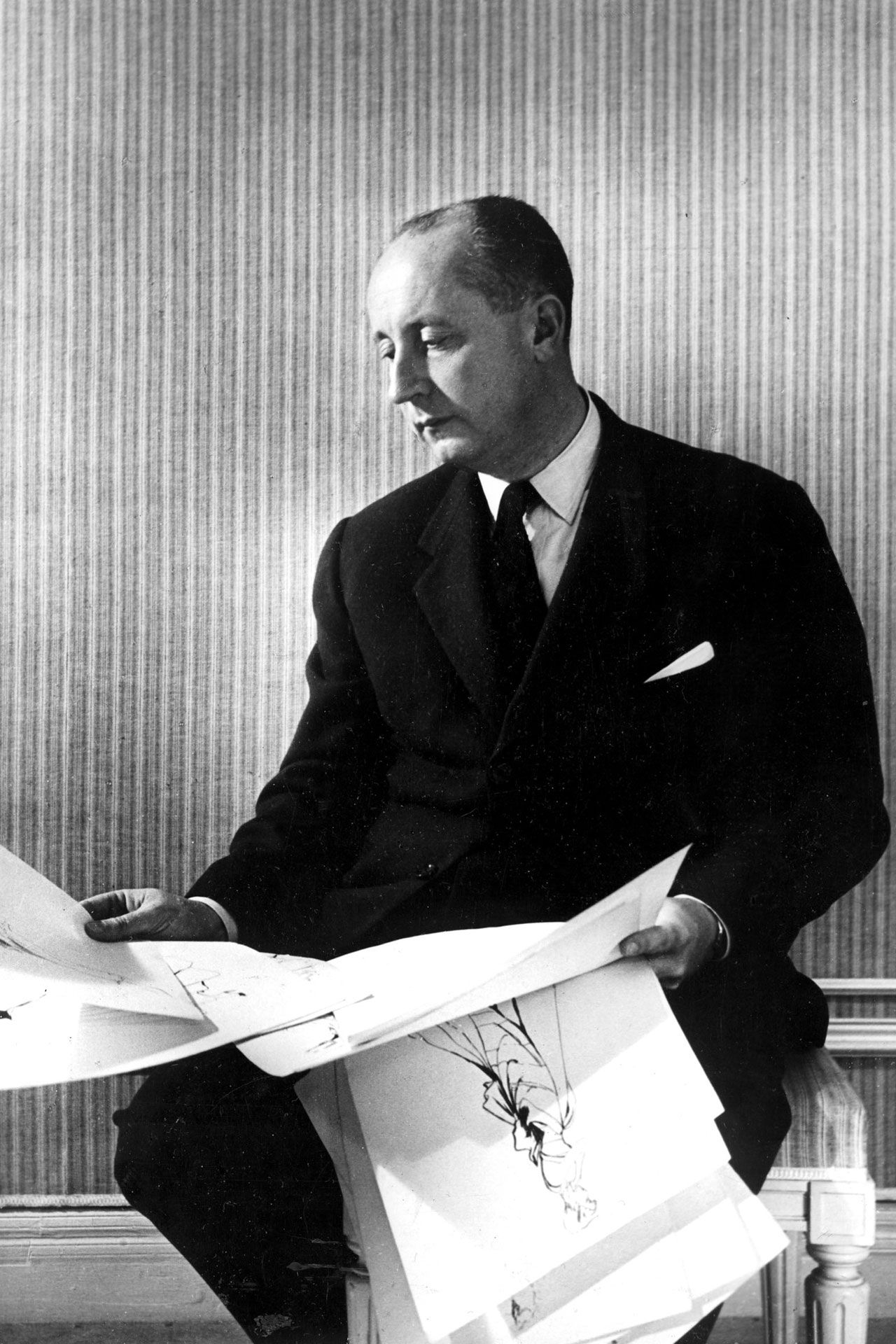
Photo of Christian Dior looking at design drafts.
Christian Dior, legendary French fashion designer who revolutionized haute couture fashion after WWII, by reintroducing femininity and focus to women’s wear.
This is an image of the Dior logo left

French Haute Couture Fashion Designer
1905-1957

1905 - Born on January 21
In Granville, a seaside town in the north of France.
1925-1928 - College
Although Dior was passionate about art and expressed an interest in becoming an architect, he submitted to pressure from his father and, in 1925, enrolled at the École des Sciences Politiques to begin his studies in political science, with the understanding that he would eventually find work as a diplomat.
1928 - Art Gallery
He graduated in 1928, and shortly after opened a small art gallery with money from his father along with his blessing. His father's one stipulation was that the family name was not allowed to appear above the door of the art gallery.
1931 - Art Gallery Closed
He was forced to close the gallery in a year that included the deaths of both his older brother and mother and the financial collapse of his father's business.
1935 - Illustrating job at Figaro Illustré
After the unfortunate closing of Dior's art gallery. He began selling fashion sketches, and in 1935 landed a job illustrating the magazine Figaro Illustré.
1938 - Hired as a design assistant by Robert Piguet
Dior was hired as a design assistant by Paris couturier Robert Piguet.
1938-1945 - Fought in WWII
When World War II began the following year, Dior served in the south of France as an officer in the French army.
1946 - Opened Dior Fashion House
Dior was backed financially by Marcel Boussac, a wealthy French textile magnate who wanted to revive luxury fashion. Boussac offered Dior the chance to take over an existing fashion house, but Dior insisted on creating his own label from scratch — Maison Dior. (House of Dior)
1947 - Introduced the New Look (En Huit - Figure 8)
He introduced the revolutionary New Look, spurring international controversy over its radically lowered hemline. Also, he released Lady Dior (first perfume). 
1950s - Dior is booming!
The overnight sensation of the New Look was followed by 10 years of outstanding success. Dior introduced a variety of new silhouettes, including the H-line, the A-line, and the Y-line. Dior was instrumental in re-establishing Paris as a world fashion capital. And regaining for Parisian couturiers the ground that had temporarily been lost to American designers.
1957 - Appeared on the cover of Time magazine
His devoted following included socialites, celebrities, and royalty. And was featured on the cover of Time magazine several weeks before his death.
1957 - Appoints his successor
He had been deeply impressed by the talent of Yves Saint Laurent, a 21-year-old assistant who had joined Dior in 1955 after winning a design competition. Dior formally named Saint Laurent as his successor, an unusual move, since he was still young and relatively unknown.
1957 - Died from a heart attack in Italy
Dior traveled to Italy to vacation. While there, on October 23, 1957, he suffered what was his third heart attack and died, at the age of 52. Dior's funeral was attended by an estimated 2,500 people, including all of his staff and many of his most famous clients. He was buried in Cimetière de Callian, in Var, France. At the time of his death, Dior's house was earning more than $20 million annually.

Christian Dior once said:

"Individuality will always be one of the conditions of real elegance."
"Real woman should be capricious."
"After women, flowers are the most lovely thing God has given the world."